Trap vs. Skeet vs. Sporting Clays: A Beginner's Guide
Trap vs. Skeet vs. Sporting Clays — Which Is Right for You?
If you're new to clay shooting, the terminology alone can feel like a barrier to entry. Trap, skeet, sporting clays, five-stand, FITASC — where do you even start?
The good news is that all three major clay shooting disciplines share the same basic concept: a shotgun, clay targets launched by a machine, and the goal of breaking as many as you can. But each one has its own rules, field setup, and skill demands, making it a unique experience.
This guide breaks down trap, skeet, and sporting clays in plain English so you can walk into any shooting range, competition, or rental event knowing exactly what you're looking at — and which one might be right for you.
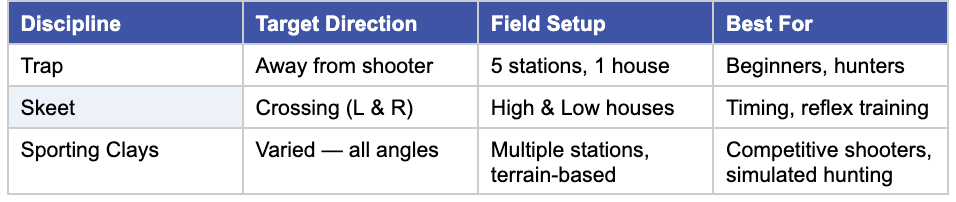
Clay Shooting Disciplines at a Glance
Here's a quick comparison before we go deeper:
What Is Trap Shooting?
Trap shooting is the most widely recognized clay shooting discipline in the United States — and for most beginners, it's where the journey starts.
In a trap, targets are launched from a single machine (the "trap" or "house") positioned in front of the shooter and angled away from the shooting stations. The machine oscillates so that each target flies in a slightly different direction, but they always move away from you.
The Trap Field Setup
A standard trap field has five shooting stations arranged in a curved line behind the trap house. Competitors rotate through each station and take shots at targets flying outward at varying angles. In a round of trap, each shooter takes 25 shots (five from each station).
Why Beginners Love Trap
- Targets always fly away — easier to track visually
- One machine, one direction — consistent and predictable
- Found at virtually every gun club and shooting facility in the country
- Great foundation for hunters learning to lead moving targets
Trap is also the starting point for many competitive shooters who eventually move into other disciplines. If you're renting machines for a corporate event or a backyard shoot, trap is typically the format that requires the least explanation for first-timers.
What Is Skeet Shooting?
Skeet shooting introduces a new challenge: crossing targets. Instead of always flying away from you, skeet targets move laterally across the field — which means you have to learn to lead the target rather than simply track it.
Skeet uses two machine houses positioned at opposite ends of a semicircular field: a high house on the left and a low house on the right. Shooters move through eight stations arranged in a half-circle between and around the two houses.
The Skeet Field Setup
At each station, shooters take shots at targets launched from the high house, the low house, or both simultaneously (called a "double"). The angles and distances change at every station, which is what makes skeet an excellent tool for developing timing, reaction speed, and the ability to read target angles.
Why Shooters Choose Skeet
- Develops faster reaction time and swing-through technique
- Two crossing targets mean more variety than a trap
- Excellent for improving performance in hunting scenarios involving crossing birds
- Regulated by the NSSA (National Skeet Shooting Association)
Skeet has a strong competitive community and is one of the Olympic shooting sports. The National Skeet Shooting Association (NSSA) governs the sport domestically and oversees national competitions.
What Is Sporting Clays?
Sporting clays is often described as golf with a shotgun — and for good reason. Instead of a fixed field layout, sporting clays courses take you through a series of stations spread across varied terrain, with targets that simulate real hunting scenarios.
Each station presents a different target presentation: crossing birds, incoming targets, overhead shots, low-flying rabbits rolling along the ground, and combinations of all of the above. No two courses are exactly alike, and no two stations within a course are the same.
The Sporting Clays Course
A sporting clays course typically features 10 to 15 stations spread over a larger footprint — often through woods, fields, and varied elevation. At each station, the shooter calls for the target (or pair of targets) and takes their shot.
Unlike trap and skeet, sporting clays uses multiple machines positioned at each station to create varied presentations. This is where the quality, consistency, and setup of the trap machines matter most — and it's why course design and machine selection are taken seriously by top clubs and event operators.
Why Competitive Shooters Prefer Sporting Clays
- The most varied and challenging of the three disciplines
- Simulates real-world hunting scenarios across different terrain types
- Course design is a craft — no two courses are identical
- Governed by the NSCA (National Sporting Clays Association)
- What Ashleigh Alexander has competed in at the national and world levels
The National Sporting Clays Association (NSCA) oversees competitions, registered shoots, and classification rankings for the sport in the United States.
Which Clay Shooting Discipline Is Right for You?
The honest answer is: it depends on why you're shooting.
Start with Trap If...
- You're a first-timer or introducing someone new to the sport
- You're planning a group event, corporate outing, or fundraiser shoot
- You want a consistent, approachable format that's easy to explain
- You're a hunter looking to improve your accuracy on birds flying away
Move to Skeet If...
- You want to work on crossing shots and reaction time
- You're looking to compete at a registered level
- You want a sport that builds transferable shotgun skills quickly
Try Sporting Clays If...
- You want the most realistic simulation of field hunting
- You're chasing a competitive challenge that never gets repetitive
- You enjoy a course-style format that changes with every round
- You're serious about competitive shooting at regional or national levels
Many shooters eventually try all three. Trap builds the foundation, skeet sharpens your speed and angle reads, and sporting clays brings it all together in the most dynamic environment the sport has to offer.
One Thing All Three Disciplines Have in Common: The Machine Matters
No matter which discipline you're stepping into, the clay target machine driving your experience is what determines consistency, reliability, and enjoyment — especially in a competitive or event setting.
Promatic trap machines are engineered specifically for the demands of clay shooting sports. Whether it's a high-volume trap field handling hundreds of rounds a day, a multi-station sporting clays course requiring varied target presentations, or a rental fleet heading out for a fundraiser event, the machine underneath every great clay shooting experience has to perform.
At Shotgun Gear, we sell, service, and rent Promatic machines specifically because we know what consistent, reliable equipment looks like from the inside out.
As a Promatic Diamond Dealer and a team with decades of competitive shooting experience behind us, that's not a marketing line — it's what we do every day.
Ready to Get Started with Clay Shooting?
Whether you're setting up your first trap field, planning an event, or looking to rent machines for a shoot — Shotgun Gear has the equipment, expertise, and experience to help you do it right.
Contact Shotgun Gear for a Quote or Consultation →
Shotgun Gear LLC | Promatic Diamond Dealer | Paris, TN | Serving the Continental U.S.
About the Author
Cyrus Alexander is the co-owner and operator of Shotgun Gear LLC alongside Ashleigh Alexander, a multi-time National Champion, World Champion, and US Open Champion in competitive shooting. With deep roots in the clay shooting industry dating back to 2009, Cyrus brings hands-on experience in trap machine sales, rentals, event planning, and course design to every project Shotgun Gear takes on.
You might also like